Canada's Export Shock Signals a Historic Shift - Why Trade With the United States Is No Longer a Sure Bet in 2026
Canadian exports are trending as trade data reveals a widening deficit, declining reliance on the United States and a strategic pivot toward gold and global markets. Here is what this shift means for Canada's economy in 2026.
Canadian Exports Enter the Spotlight as Trade Patterns Break Decades Old Trends
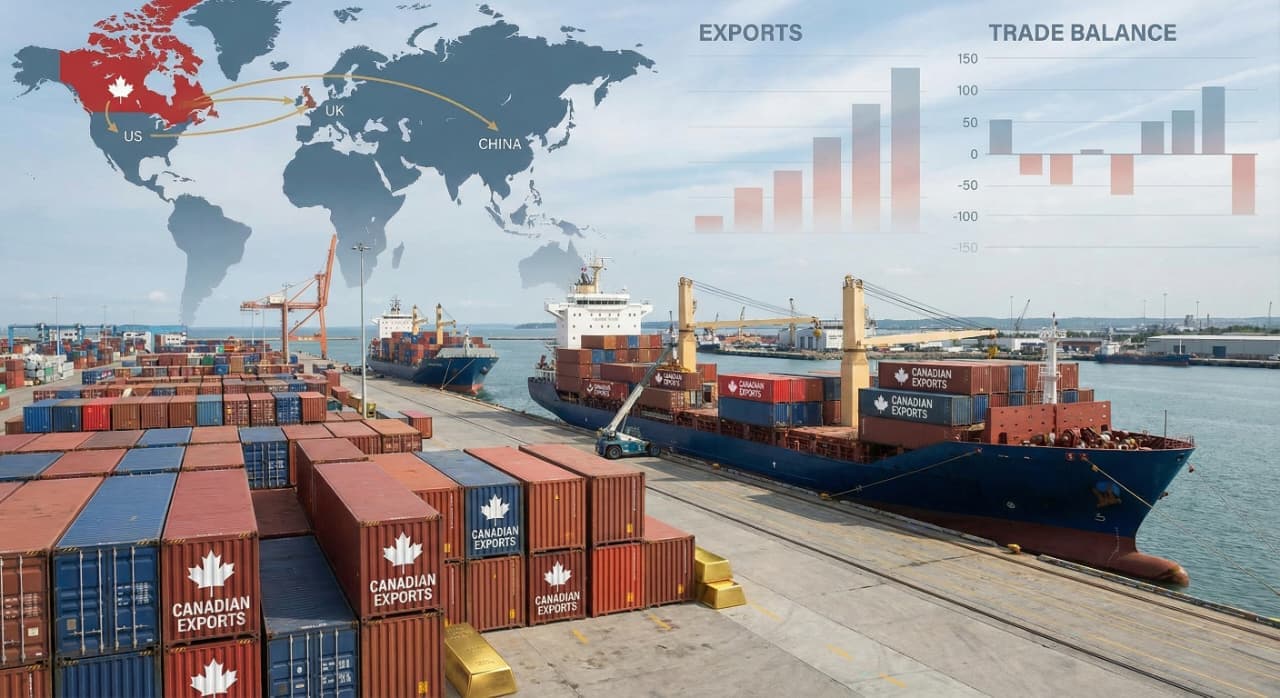
Canadian exports have surged into public and market attention after new data revealed a sharp shift in the country's trade position. Canada moved into a trade deficit as export growth failed to keep pace with a rapid increase in imports, signaling a deeper transformation in how the country engages with global markets. This trend marks a clear departure from the long standing model where the United States dominated Canadian export demand.
For decades, Canada relied heavily on its southern neighbour to absorb energy, manufactured goods and raw materials. That relationship is now evolving as structural changes in global supply chains, geopolitics and domestic policy push Canada toward a more diversified export strategy.
Exports to the United States Fall to the Lowest Share in Decades
One of the most striking developments is the decline in Canada's share of exports destined for the United States. Recent figures show that this share has dropped to levels not seen in generations, reflecting a gradual but decisive rebalancing of trade relationships. While the United States remains Canada's largest trading partner, its dominance is no longer absolute.
This shift is driven by multiple forces including changing U.S. demand, protectionist pressures, and Canada's growing engagement with alternative markets across Europe and Asia. Exporters are increasingly seeking resilience by reducing exposure to a single market, especially in an era marked by political uncertainty and economic volatility.
Gold and Resource Exports Play a Growing Role
A notable feature of Canada's export diversification is the rising prominence of gold. As global investors search for stability amid inflation risks and geopolitical tension, gold exports have become an important contributor to Canada's trade flows. This reflects broader global demand dynamics rather than short term speculation.
Gold's role highlights how Canada is leveraging its natural resource strengths while adapting to shifting global preferences. Resource exports remain central to the economy, but the composition of those exports is changing in response to international market signals rather than traditional bilateral trade patterns.
Imports Rise Faster Than Exports and Reshape Trade Balance
At the same time, Canada is experiencing a rapid increase in imports that historically would have been sourced from or offset by exports to the United States. Analysts point to supply chain reconfiguration, consumer demand and industrial inputs sourced from a wider range of countries as key drivers.
This imbalance has pushed Canada into a trade deficit, raising questions about sustainability and long term competitiveness. However, economists caution that deficits during periods of transition are not necessarily negative if they accompany strategic realignment and future export growth.
What This Means for Canada in a Global 2026 Economy
The emerging trend in Canadian exports signals a pivotal moment for the country's economic identity. Rather than anchoring growth almost exclusively to the United States, Canada is positioning itself as a more globally integrated trading nation. Stronger ties with Europe, China and other Asian economies could reduce vulnerability to regional shocks while opening new avenues for growth.
For global investors and policymakers, this evolution matters. It affects currency dynamics, commodity pricing and long term investment flows. In 2026, Canada's export strategy is no longer about volume alone but about balance, resilience and global reach.
This article is for informational purposes only and does not constitute financial or economic advice. Trade data and market conditions are subject to revision and change.