A Mall Icon Quietly Disappears - Why Francesca's Is Closing All Stores and What It Signals for Retail in 2026
Francesca's sudden liquidation and nationwide store closures reveal deeper cracks in mall based retail as consumer behaviour shifts faster than brands can adapt.
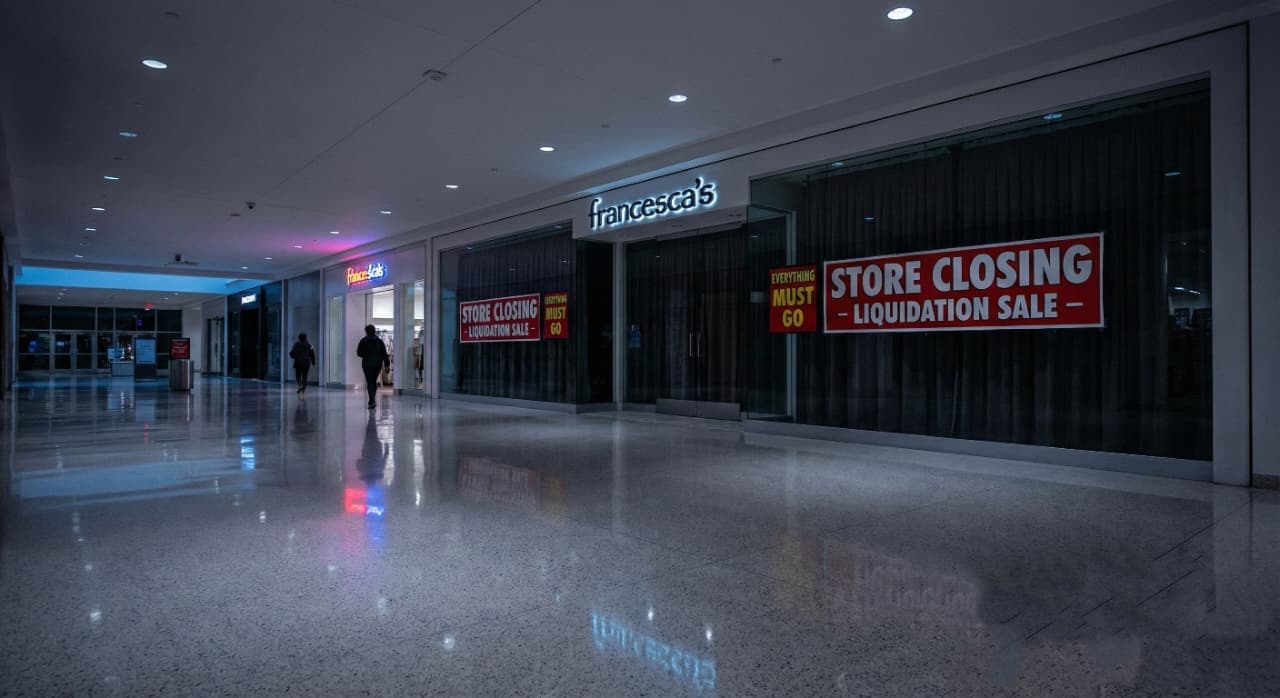
Francesca's Moves Toward Full Shutdown as Liquidation Begins
Francesca's, once a familiar name in shopping malls across the United States, is closing all remaining stores after entering Chapter 11 bankruptcy proceedings. The decision marks the end of a long struggle for the women's apparel retailer, which built its brand on small boutique style locations and impulse driven mall traffic.
Liquidation sales have already begun at locations nationwide, signaling that the company is not pursuing another restructuring attempt. For many shoppers, the closures appeared sudden. For employees, the end came with little warning.
Employees Caught Off Guard as Stores Go Dark
Multiple reports indicate that store level workers were informed of closures with minimal notice, in some cases learning of job losses as liquidation plans were rolled out. While the company has not publicly detailed its internal communication process, the situation has raised questions about worker protections during retail bankruptcies.
Retail analysts note that this pattern has become increasingly common as distressed companies prioritize speed and cost reduction during shutdowns, often leaving frontline staff with limited transition support.
Why Francesca's Could Not Survive Another Retail Reset
Francesca's business model depended heavily on mall foot traffic, seasonal fashion cycles, and discretionary spending. These pillars have weakened over the past several years as consumers shifted toward online shopping, value focused retailers, and fast fashion alternatives with lower prices and faster inventory turnover.
Rising operating costs, including rent, logistics, and labor, further compressed margins. Attempts to reposition the brand digitally failed to offset declining in store sales, leaving the company vulnerable when consumer spending softened again entering 2026.
A Symbol of Mall Retail's Ongoing Decline
The collapse of Francesca's is not an isolated event. Mall based retailers across the United States and the UK continue to face shrinking foot traffic as shopping centers lose relevance outside of top tier locations. In China, a similar shift toward digital first retail and experiential shopping has reshaped consumer expectations, leaving traditional apparel chains struggling to remain competitive.
What distinguishes Francesca's closure is how quietly it unfolded. There was no last minute rescue, no acquisition, and no strategic pivot. The brand simply ran out of options.
What This Means for Shoppers and the Broader Economy
For consumers, the immediate impact is limited to clearance sales and store closures. For the retail sector, however, the implications are broader. Francesca's exit reinforces the reality that mid sized apparel brands without strong online differentiation or pricing power are increasingly at risk.
Economists view these closures as part of a larger retail recalibration rather than a sudden crisis. Still, job losses and vacant mall spaces continue to ripple through local economies, particularly in smaller cities where retail employment remains a key source of income.
Retail in 2026 Is No Longer Forgiving
The downfall of Francesca's highlights how unforgiving the retail environment has become. Brands must now compete globally, manage costs precisely, and adapt rapidly to shifting consumer behaviour. Those that fail to evolve quickly enough risk disappearing with little warning.
As 2026 unfolds, more retailers may face similar outcomes, especially as economic uncertainty persists in the United States, the UK, and major global markets.
This article is based on publicly available reports and industry analysis. Details may evolve as bankruptcy proceedings continue.